Paris Is Having an Art Affair – And Almine Rech Is at the Centre of It
Art Basel Paris 2026: Picasso, Calder and the Art of Falling in Love – Inside Almine Rech’s Extraordinary Lineup
At the Grand Palais this October, Almine Rech brings together the masters who shaped modern art and the contemporary visionaries rewriting its future. From Alexander Calder’s poetic movements to Robert Indiana’s monumental declaration of LOVE, this is one encounter Parisian art lovers should not miss.
By Shari Inessa | WHAT WE ADORE Magazine
PARIS, OCTOBER 2026 – Some love affairs begin with a glance. Others, with a masterpiece.
As Paris prepares to welcome the international art world for Art Basel Paris, October 23–25, 2026, the magnificent Grand Palais is once again becoming the epicentre of artistic desire. Collectors, curators, cultural tastemakers and those who simply appreciate the extraordinary will gather beneath its celebrated glass roof for a few days when art takes precedence over almost everything else.
And among the presentations promising to command attention, Almine Rech, at Booth A16, is preparing something rather irresistible.
Forget the predictable chronological parade of art history. Here, Picasso encounters contemporary experimentation, Calder flirts with gravity, and Robert Indiana reminds us that four letters can carry an entire universe of meaning. This is not merely a presentation of exceptional artworks. It is a conversation across generations, continents and artistic languages.
And what a conversation it promises to be.
When Picasso Meets the Future
There is something wonderfully audacious about placing the great artistic revolutionaries of the twentieth century alongside the restless minds of today.
At Almine Rech, Pablo Picasso, Alexander Calder, Leonora Carrington and Tom Wesselmann share the spotlight with an international constellation of artists including Ha Chong-Hyun, Kim Tschang-Yeul, Taryn Simon, Ali Cherri, Francesco Vezzoli, Thu-Van Tran and Joël Andrianomearisoa.
Different generations. Different disciplines. Different obsessions.
Yet the same irresistible impulse: to challenge how we see the world. The selection moves between painting, sculpture, photography and mixed media, creating unexpected connections between artistic movements that might initially appear worlds apart. It is precisely this refusal to separate past from present that makes the presentation compelling. Great art, after all, rarely respects the boundaries we invent for it.
Alexander Calder: The Beautiful Art of Losing Control
Few artists have understood the seductive possibilities of movement quite like Alexander Calder.
His Untitled, circa 1940, is among the presentation’s most fascinating highlights. A standing mobile composed of delicate metal elements painted in vibrant orange, yellow, red and blue, the sculpture appears almost impossibly light. Its forms balance with exquisite precision, responding to their surroundings with subtle movements. But there is a delicious surprise.
Calder’s sculpture does not simply move. It can also make music. As its elements occasionally collide, they produce delicate, unpredictable sounds, transforming the artwork into an experience that engages both sight and hearing.
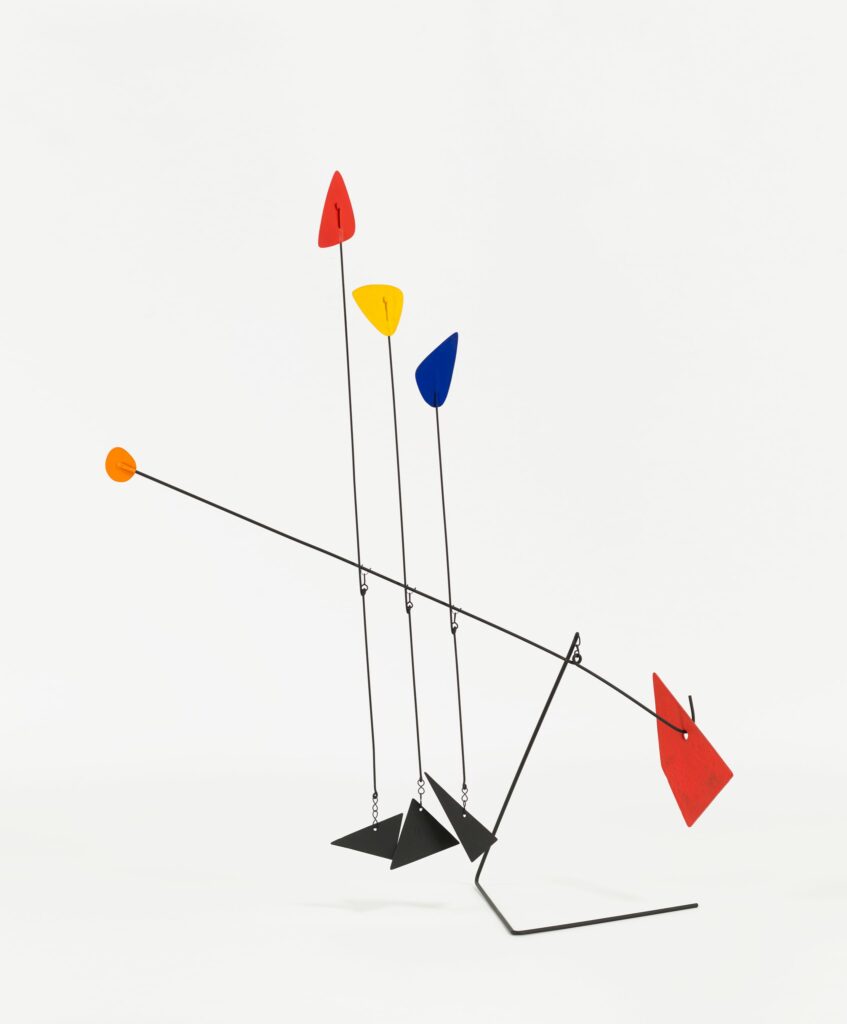
Alexander Calder
Untitled, c. 1940
Sheet metal, wire, and paint
114.3 x 68.6 x 48.3 cm
45 x 27 x 19 in
© 2026 Calder Foundation, New York / ADAGP, Paris Courtesy of Calder Foundation and Almine Rech
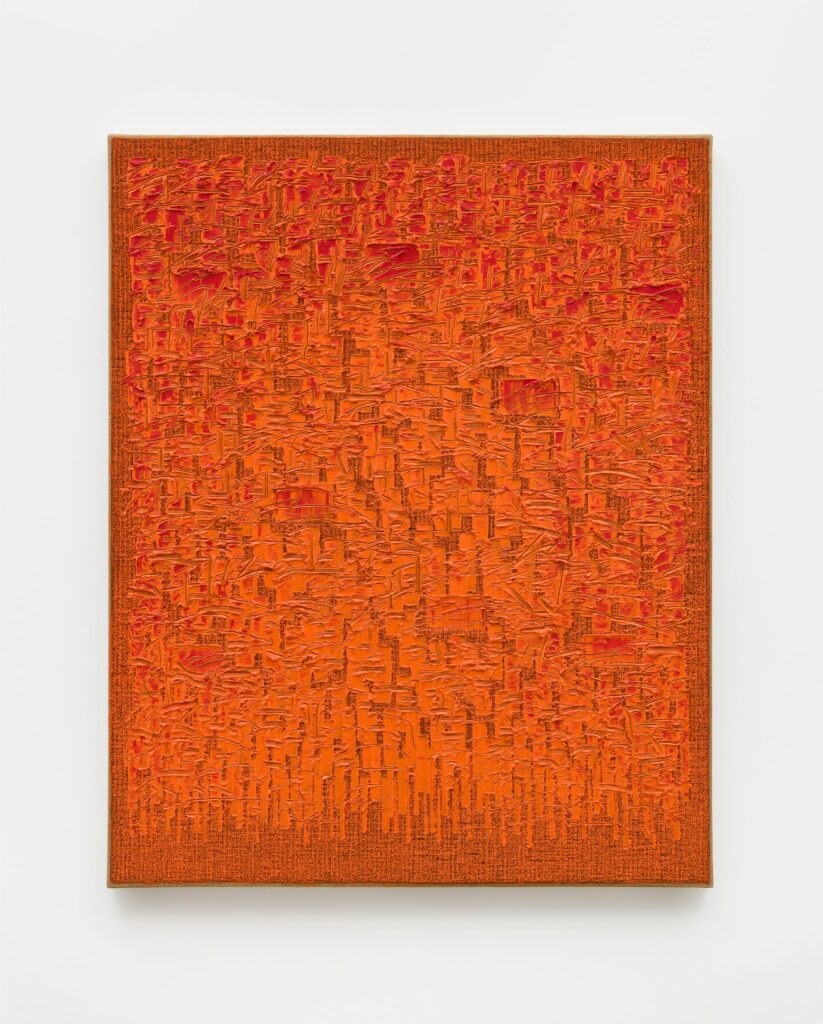
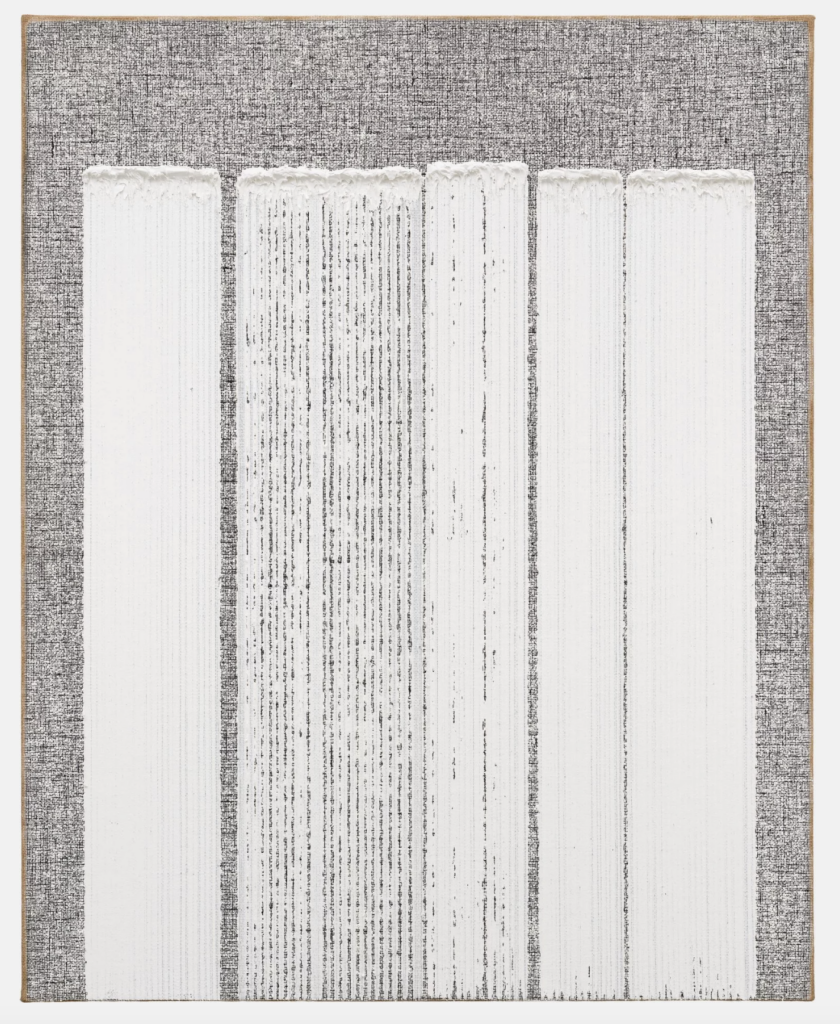
Ha Chong-Hyun
Conjunction 23-96, 2023 Oil on hemp cloth
162 x 130 cm
64 x 51 in
© Ha Chong-Hyun
Photo: OnArt Studio
Courtesy of the Artist and Almine Rech
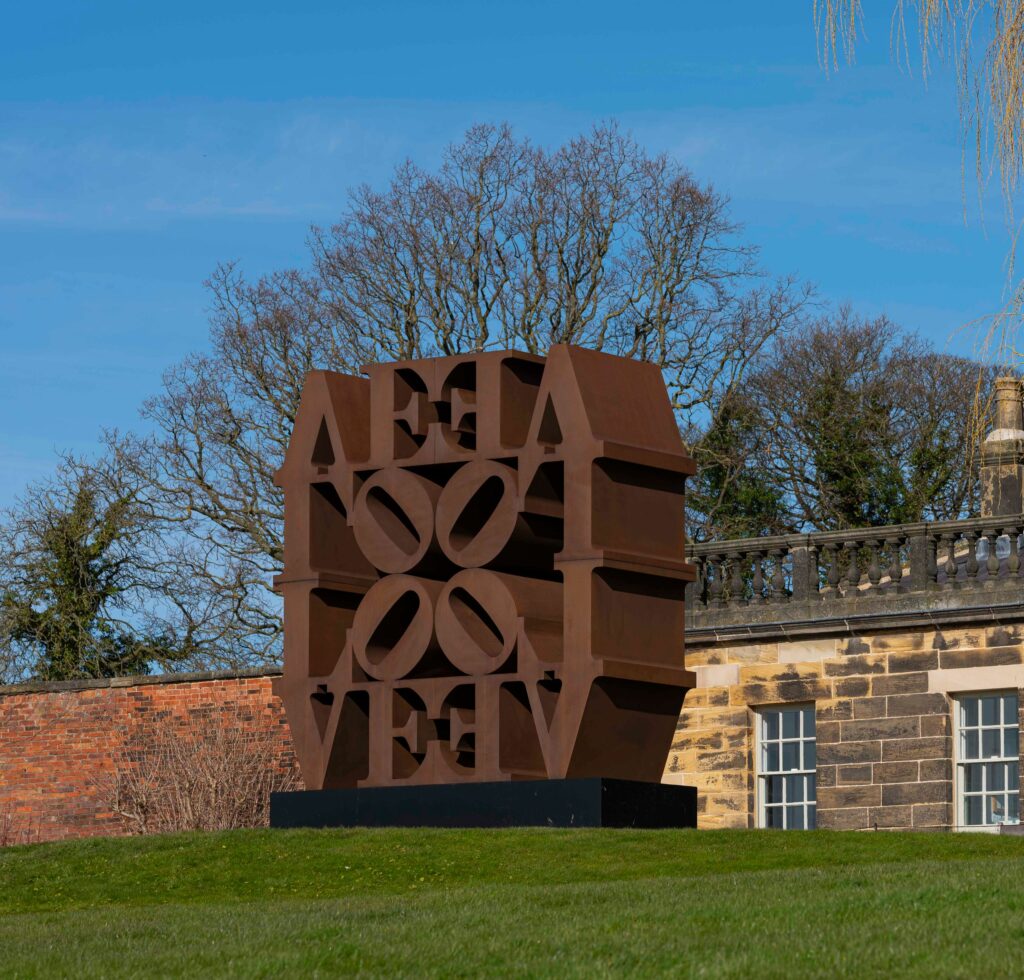
Robert Indiana
LOVE Wall (1966–2006)
Installation view at Yorkshire Sculpture Park, 2022. Artwork: © The Robert Indiana Legacy Initiative/Artists Rights Society (ARS), NY
Photo: Jonty Wilde
Courtesy of Yorkshire Sculpture Park
A sculpture that refuses to remain silent.
There is something profoundly modern about that idea, even more than eight decades after its creation. In Calder’s universe, perfection is not immobility. It is the beautiful possibility that something unexpected might happen.
Ha Chong-Hyun: When Colour Becomes an Experience
Across the artistic spectrum, Korean master Ha Chong-Hyun offers a radically different kind of intensity.
His Conjunction 23-96 (2023), an extraordinary composition in oil on hemp cloth, reveals the physical intelligence behind his celebrated practice. A leading figure of Dansaekhwa, the Korean monochrome painting movement, Ha developed an unconventional technique of pushing paint through the reverse side of the canvas. The result is not simply an image but a surface with its own architecture. Texture becomes language. Colour acquires weight. The canvas ceases to be merely a support and becomes an active participant in the artwork.
At a time when so much of contemporary visual culture is consumed through screens, Ha’s paintings remind us of something essential: art is also material, gesture and physical presence.
Sometimes, the most powerful works are those that demand we come closer.
Robert Indiana: LOVE, But Make It Monumental
And then, naturally, there is love.
Not the discreet, whispered variety. The monumental kind. As part of Art Basel Paris’s Public Program, Almine Rech will present Robert Indiana’s LOVE Wall, a commanding sculpture that transforms one of the most recognisable symbols in modern art into an architectural statement.
Created in 2006 from a composition first explored by Indiana in 1966, the work brings together four iterations of the word LOVE, arranged in a striking geometric configuration. Two upright. Two inverted. Four letters endlessly repeated and reinvented. It is graphic, sculptural and emotionally immediate.
Indiana understood something that contemporary culture continues to demonstrate: a simple image, when conceived with sufficient intelligence, can become universal. Yet behind the familiar typography lies a deeply personal history, rooted in the artist’s childhood and his relationship with spirituality, identity and language. For Paris, the presentation offers an opportunity to rediscover the complexity behind an image that has become part of our collective visual memory.
And perhaps to remember that love, like great art, never really goes out of style.
The Artists Defining the Cultural Conversation
Beyond the established masters, Almine Rech’s presentation offers a fascinating glimpse into the artists currently shaping international institutional conversations.
Lebanese artist Ali Cherri will present works from The Forbidden Fruit, a sculptural series that coincides with his solo exhibition TODAY IS OK at the Palais de Tokyo, running from October 2026 through February 2027. Meanwhile, Joël Andrianomearisoa, a finalist for the 2026 Prix Marcel Duchamp, continues to explore the poetic territories of memory and emotion. His work is also being presented at the Musée d’Art Moderne de Paris and the 18th Lyon Biennale.
Thu-Van Tran brings another compelling perspective, with her practice simultaneously represented in exhibitions in Berlin, Lyon and Boulogne-Billancourt.
And across the Atlantic, Taryn Simon is making institutional history at New York’s Guggenheim Museum with Father Country I Do Love You, a major exhibition running from September 2026 to March 2027. Her work One little room on fire (2026), included in the Almine Rech presentation, belongs to this latest body of work. These simultaneous exhibitions offer a reminder that Art Basel Paris is more than a marketplace for exceptional objects.
It is a meeting point for ideas already transforming the world’s most important cultural institutions.
John Giorno: Poetry at the Push of a Button
Among the presentation’s more unexpected encounters is John Giorno’s DIAL-A-POEM (Push-Button Edition), 1968–2019.
The concept dates back to 1968, when Giorno developed a project that allowed people to access poetry by telephone.
It was radical in its simplicity: art could leave the gallery, enter everyday life and become accessible to anyone willing to listen. Decades before our obsession with instant digital content, Giorno was already experimenting with new ways of connecting artists and audiences. As December 2026 marks the 90th anniversary of his birth, the work feels especially relevant. Perhaps the most avant-garde gesture is not to make art more complicated.
Perhaps it is to make it impossible to ignore.
Paris, Art and the Pleasure of Discovery
There is a particular magic to Paris during its great cultural gatherings.
The city becomes a living extension of the exhibitions themselves. Conversations spill from galleries into restaurants, from private collections into late-night dinners, and from the Grand Palais into the streets beyond. Art becomes part of the city’s rhythm. For the 2026 edition of Art Basel Paris, Almine Rech captures this spirit through a presentation that refuses to choose between historical importance and contemporary urgency.
It celebrates artistic legacy without becoming nostalgic. It embraces experimentation without forgetting beauty. And it reminds us why we continue to seek out extraordinary works of art in the first place. Not simply to admire them.
But to feel something.
Because in the end, the greatest luxury is not owning a masterpiece. It is being moved by one.
THE DETAILS
Almine Rech at Art Basel Paris 2026
Dates: October 23–25, 2026
Vernissage: October 22, 2026, 2–8 PM
Opening hours: 11 AM–7 PM, October 23–25
Location: Grand Palais, Avenue Winston Churchill, 75008 Paris
Booth: A16
Website: https://www.alminerech.com
Instagram: @alminerech
Art Basel: https://www.artbasel.com
By Shari Inessa
Editor-in-Chief, WHAT WE ADORE Magazine
Recommended
-
Paris Is Having an Art Affair – And Almine Rech Is at the Centre of ItOctober 13th, 2026
-
FROM MIRÓ TO PICASSO: PARIS AFTER DARK AT MASH 2026October 13th, 2026
-
ONE TO WATCH AT DESIGN MIAMI PARIS: JEAN TOURET’S L’ÂGE DE FERSeptember 30th, 2026
-
ART BASEL PARIS 2026: THE REAL SHOW EXTENDS FAR BEYOND THE GRAND PALAISSeptember 21st, 2026
-
THE ART EXHIBITION TO SEE IN PARIS THIS OCTOBER: TRACEY EMIN AT WHITE CUBESeptember 21st, 2026